
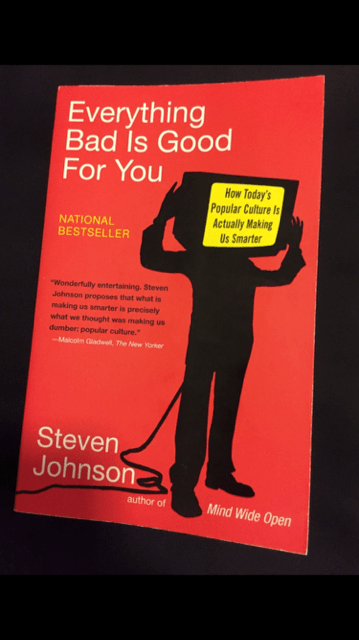
Contrary to popular belief, popular culture isn’t dumbing down concepts or reducing us to piles of mashed couch potato. Television programs and video games engage modern audiences in ways that deepen cognitive capacity. Steven Johnson writes, “The story of the last thirty years of popular culture is the story of rising complexity and increased cognitive demands.” Everything Bad is Good for You is a heartening take on popular culture that runs counter to accepted wisdom. People have long argued that modern games and media are both riddled with sex and violence, and devoid of edifying content. Not so, claims Johnson. In one illustration, Johnson maps out the family tree in the show Dallas and compares it to intricate web of characters and families in 24. It’s not even close how much more complex the interlocking relationships of 24 are. When it comes to plot, there might be layers that are introduced and go unexplored for a few episodes before they are brought back again as crucial elements. Often modern shows will pick up the thread instantaneously without explanation or preamble and viewers are expected to follow nimbly along.
Johnson goes out of his way to point out that not all TV shows and video games are alike. While many of the award-winning titles that media critics decry as slop do enhance our cognitive powers, others provide empty calories. It isn’t a particular format, like cable drama or reality show, that makes the difference. Rather, it’s more about the complexity of the personalities, plot developments, and volume of interdependent threads of the story that makes the difference. One can make an expertly crafted police drama or an intellectually impoverished documentary. The cognitive payoff depends on the investment the creator demands of the audience.
The same holds true for video games. Often derided as a time-wasting activity, Johnson argues that many games make their players smarter. He contends that games are actually an incredibly practical way of learning the scientific method. Players don’t just passively absorb the plot or unfolding levels of a good game. Players probe, explore, hypothesize, and experiment their way to success. They have to learn the physical and social laws of new worlds. They have to test and retest boundaries. They have to interpret the results and make consequential choices based upon their interpretations. They get real-time feedback about when they have guessed rightly or wrongly. Sometimes it’s not even clear what the expected outcome of a game is or what success actually looks like. You have to figure that out for yourself as you go. What better preparation for life as a 21st century knowledge worker could there be?
 book reading life