For anyone who’s ever had a hellish customer service experience, this is a story for you. You can think of it as a mini tribute to the overworked customer. We’ve all been there at one time or another. We get a product as a gift or sign up for a service. Everything seems to go great at first. Then, disaster strikes. The product fails, the service isn’t what’s expected, or some completely unrelated event renders our purchase unusable. You’re forlorn, left adrift. There’s nowhere to turn. Then it dawns on you that there are people – a whole group of them – who’s sole purpose of existing is helping you navigate the very type of predicament you find yourself in now. They are customer service. You reach out to them, and boy does it not go well.
Benoît Duteurtre plumbs the maddeningly terrible depths of customer service failures in this crisp, hilarious yarn. Our hero in this tale is a decidedly technophobic individual who briefly overcomes his technophobia to embrace his parents’ gift of a smartphone. He is rewarded for his bravery and tolerance with the unfortunate luck of losing his new phone. From there, his life becomes consumed with battling the corporate minions that appear determined to place every obstacle possible between him and accomplishing the goal of replacing his phone. From hold music to internet cafés to waiting rooms to plane trips, the runaround by customer service has him running all over.
This book is more rant than rumination, but it’s fun and relatable. Read this story and it probably won’t change your life. It won’t change your opinion about customer service or the role of tech gadgets in modern life. But I can guarantee you one thing: you will never forget the name Leslie Delmare.
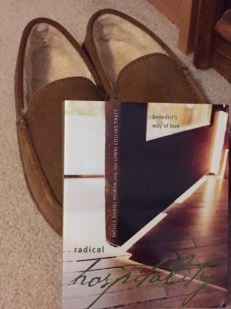
At its most basic, hospitality means saying “welcome in” to the friend and the stranger alike. This doesn’t mean you share the same intimacy with a stranger as with a friend. It only means you’re open to and grateful for the gift of discovering what any person has to offer no matter who they are. Father Daniel Homan and Lonni Collins Pratt unpack the virtue of hospitality and what it means today in Radical Hospitality: Benedict’s Way of Love. Their interpretation flows from the monastic spirituality of St. Benedict, who in his Rule of St. Benedict set the expectation that monks extend hospitality to others. Hospitality is for everyone, not just monks. While hospitality has become associated with hotels, tourism, and the business of keeping people entertained, the authors explain that it is about relationships. Hospitality expresses itself in relationships that start with gratefulness for the gift of encountering someone else instead of mistrust, suspicion, or – worst of all – the desire to use another as an instrument to our ends.
Radical Hospitality: Benedict’s Way of Love
Stories abound in holy texts, especially those passed on by desert people (like the Bible or the Qur’an), of the importance of hospitality. It was a life or death matter for travelers in earlier eras. And in many parts of the world or in the case of refugees fleeing their home countries, it is still a matter of life and death today. Even outside of these dire circumstances, the spirit of hospitality calls us to a more authentic way of relating to each other. We can choose to see in other people a grace that we admire, a skill we share, or a virtue we seek. So often when we search for the good in others, we find it in ourselves. When we focus on the evil, it appears in us too. Perhaps in learning hospitality toward others, we learn to live with ourselves. We learn to accept our faults when we can more tolerably overlook the faults of our fellow travelers. Through hospitality, we learn the courage to be kind – both to ourselves and those very different from us.
Even as we create a more technologically advanced world, we need to make it hospitable. We need to make it a fit place for spiritual beings to reside in. Sending an email, joining a video conference, or posting on someone’s website are the new ways we sometimes welcome others into our home or enter as strangers into someone else’s. Technology makes us more accessible to each other through communication tools. Consequently, we have to make sure that when we access each other we do so in a way that is humane and hospitable. Sending and receiving information has never been so easy, but it has probably never been so difficult to maintain the level of hospitality required. I am grateful to Homan and Pratt for the depth of their study of hospitality and the accessible way in which they communicate it in Radical Hospitality. At its most basic, hospitality means saying “welcome in”- easier to say about your house than about your heart.
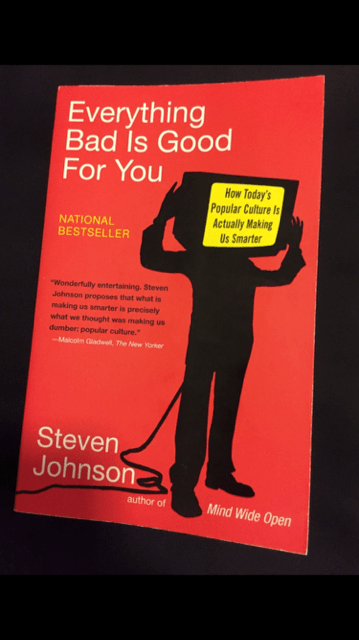
Contrary to popular belief, popular culture isn’t dumbing down concepts or reducing us to piles of mashed couch potato. Television programs and video games engage modern audiences in ways that deepen cognitive capacity. Steven Johnson writes, “The story of the last thirty years of popular culture is the story of rising complexity and increased cognitive demands.” Everything Bad is Good for You is a heartening take on popular culture that runs counter to accepted wisdom. People have long argued that modern games and media are both riddled with sex and violence, and devoid of edifying content. Not so, claims Johnson. In one illustration, Johnson maps out the family tree in the show Dallas and compares it to intricate web of characters and families in 24. It’s not even close how much more complex the interlocking relationships of 24 are. When it comes to plot, there might be layers that are introduced and go unexplored for a few episodes before they are brought back again as crucial elements. Often modern shows will pick up the thread instantaneously without explanation or preamble and viewers are expected to follow nimbly along.
Everything Bad Is Good For You by Steven Johnson
Johnson goes out of his way to point out that not all TV shows and video games are alike. While many of the award-winning titles that media critics decry as slop do enhance our cognitive powers, others provide empty calories. It isn’t a particular format, like cable drama or reality show, that makes the difference. Rather, it’s more about the complexity of the personalities, plot developments, and volume of interdependent threads of the story that makes the difference. One can make an expertly crafted police drama or an intellectually impoverished documentary. The cognitive payoff depends on the investment the creator demands of the audience.
The same holds true for video games. Often derided as a time-wasting activity, Johnson argues that many games make their players smarter. He contends that games are actually an incredibly practical way of learning the scientific method. Players don’t just passively absorb the plot or unfolding levels of a good game. Players probe, explore, hypothesize, and experiment their way to success. They have to learn the physical and social laws of new worlds. They have to test and retest boundaries. They have to interpret the results and make consequential choices based upon their interpretations. They get real-time feedback about when they have guessed rightly or wrongly. Sometimes it’s not even clear what the expected outcome of a game is or what success actually looks like. You have to figure that out for yourself as you go. What better preparation for life as a 21st century knowledge worker could there be?
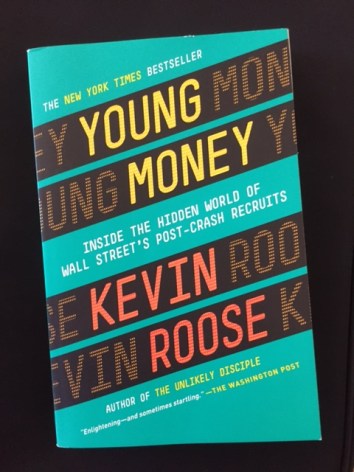
Perhaps more than any generation before us and certainly no less than any other, millennials seek work imbued with meaning beyond a paycheck. The aspiring young financiers profiled in Young Money: Inside the Hidden World of Wall Street’s Post-Crash Recruitsaren’t exceptions to that. Sure, they seek power, status, accomplishment, access – and, of course, money. But for most of them these things don’t win out over the inescapable emptiness they find in the dismal labyrinth of Excel spreadsheets that is the life of a young analyst on Wall Street. In many cases, they have reached the pinnacle of post-graduation success only to find a winding staircase of further obstacles and challenges that leads to yet grander heights of worldly success. In the end, they’re less afraid of the failure to reach those heights than the emptiness awaiting them in the corner office.
Kevin Roose brilliantly dissects the Wall Street recruiting machine. He exposes the process that leads directionless overachievers down a well-travelled road to material riches. The road serves as a sort of “cashing-in” on their abundance of talent, ambition, and fear. Many start out having drunken the Kool-Aid that they are somehow serving the wider good of society, rather than fueling a financial engine that allows the vast corporate empires they work for to amass more wealth and enrich those at the highest rungs of the corporate ladder. Others admit full well the moral compromises their work involves, but they crave the money to pay off their student loans quickly and the chance to learn skills they might transfer to the work they want to do later. Sometimes that works out, but for many later never quite arrives.
Probably the best part about this book is the sympathetic portraits Roose writes about his young up-and-coming subjects. He’s both sensitive to and objective about their efforts to reconcile the inclination to achieve with the yearning for purposeful work. Having entered the workforce post-recession, this generation of recruits clings to the security of an established foothold of economic power, while at the same time acutely aware of both its moral precariousness and vulnerability to hubristic collapse. Even as the harried young financial footsoldiers pull themselves back and forth to the office (when they do indeed leave it), this awareness induces a chronic psychological strain. It’s a tough thing to watch the best and the brightest mortgage their souls like that. It makes you wonder about those on the other side of the trade. And it reminds you of the peace we all have to make with how we choose to spend our time on this earth.
Forget what you think you know about nuns and the role of women in the Catholic Church. Jo Piazza’s If Nuns Ruled the World: Ten Sisters on a Mission serves up ten profiles in courage that will alter your perception of Catholic religious women. Leaders and activists, the American women Piazza profiles exemplify what it means to live out a commitment to social justice. Piazza shines a spotlight on the way each of these unique women carves out a niche within which she makes a remarkable contribution to the Church and the whole of American society.
To take one example, Sister Jeannine Gramick advocates for gay rights, including gay marriage. Often exposing herself to criticism and reprimands from other Catholic leaders, Sister Jeannine promotes dialogue, outreach, and advocacy for a more inclusive Church and society that embraces gay men and women in the totality of who they are in relationship to one another. The seedling of her calling to this mission grows from meeting a handsome gay man at a party one night. What then starts as a home ministry blossoms into a full-blown organization, and eventually multiple organizations. Sister Jeannine’s courage to promote gay rights and establish a connection to and from a Catholic community from which gay people have been alienated is, for her, all part of the Christian mission to bring God’s children together in love.
Sister Tesa Fitzgerald founded Hour Children to help women in prison connect with their children while they serve out their sentences. Sister Simone Campbell assumes the unenviable task of taking Catholic social justice issues to the sources of America political power. Meanwhile, Sister Nora Nash bellies up to power brokers of the corporate variety as an activist investor of sorts. What they all have in common is the capacity to defy any stereotypical or popularized version of what it means to live their vocation as religious women. They have chosen to model self-gift. By taking their individual gifts and gifting them back to a culture in which they often represent the counterculture, they have shown us a way of Christian living as old as Christianity itself.
As individuals working independently and as kindred spirits working collectively to shape a more inclusive America, the nuns profiled in this book give witness to living a contemplative life that is active in the world. They are examples of modern heroism and evidence of the spiritual riches that come from meaningful work. They may not generate the kind of wealth that accrues on balance sheets, but the value they create and the dividends they generate grow the common good.
Written as a letter from a father, Ethan Hawke’s Rules for a Knight brings together the collected wisdom of sages as diverse as Peter Drucker, Nelson Mandela, Thich Nhat Hanh, and Julian of Norwich. Hawke surveys knightly virtues such as gratitude, courage, and discipline. What ties them together is the central story of a grandfather passing on wisdom to his children and the tight, unadorned prose he uses to capture his thoughts.
There’s a sense of respect and reverence that flows through these passages on chivalrous values. It’s a reverence for the virtues themselves and their role as the mortar of civilized society, but it’s a reverence also for the task of passing on knowledge from one generation to the next. The sacredness of this task is not lost on the father penning these pages. There is an awareness that to have lived the virtues is essential, but nearly as essential is to pass on the lessons of one’s life that are learned at the price of grief, pain, and sacrifice.
A particularly choice example of this is when Thomas (the father and knight) tells the story of how he came to love the children’s mother. It’s one of the most honest and candid accounts of true love in literature I can recall. He contrasts it with the fairytale romance of “falling in love” that so many stories exemplify, often imparting a faulty understanding of love. Thomas contrasts love with passion and spells out the key difference by illustrating it with a love story from his own life.
One of the unexpected benefits of Hawke’s approach with this book is an awareness of how the lessons we learn in our own lives build on those our elders have taught us. Over time, we extend the wisdom we have received from others through our own experiences. In turn, we then build on what we learned by passing it on to those who will live after us to continue to extend this collective wisdom with their own life lessons. Rules for a Knight contains many essential truths, but none more essential than the duty to share the lessons of our lives with future generations.
My reflection on Life and Holiness by Thomas Merton
Ordinary perfection and holy humanism aren’t terms that mean much to the modern ears that may hear them. So why, when they sparkle between the lines of Thomas Merton’s Life and Holiness, do they nonetheless have the power to captivate? Perhaps we have a sense that our lives mean more than completing tasks, making money, providing for family and friends, creating art, and speculating about the future. These goals may mean a great deal to us, as they should. Yet, so much of what gives meaning in life also comes from the ordinary, chance encounters with people we know and people we don’t. We have the opportunity to be charitable or not to be, to witness to what we stand for or not to. We can be faithful to what we know to be true or not be. These ordinary choices matter.
Life and Holiness by Thomas Merton
Thomas Merton could be referred to as a saint of the unsaintly. He espouses the saintliness of the everyman. And he does it in a way that doesn’t cheapen sainthood. He doesn’t say you’re okay as you are. What he does is simply put sainthood within your grasp as an ordinary person. He says no matter how difficult it is to live a life of honest and pure faith, no one is exempt from the invitation to love. We all have the capacity and the responsibility to love as deeply as we can. Each must serve God and one another in the unique, irreplaceable manner only he or she can. Our lives – all our lives – are pedestals that honor the values we hold dearest or we have ignored the Christian vocation that has stared us in the face since baptism. He makes no bones about the sacrifice involved and the self-discipline required; it’s the ducking out of discipleship he flatly refutes.
Merton makes it clear there isn’t one way to be holy, just as there can’t possibly be only one way to do God’s will. No, God’s will for each of us is as particular to us as it is inescapably ordinary – meaning that it is ordained to apply to everyone. No matter how important society or the organizations we work for may consider us, there is an inner call to holiness that is absolutely direct in relation to us. Religious experiences mediated by the Church and others provide a surely very helpful road; however, the map to spiritual fulfillment is written in some ways more completely on the heart than anywhere else. And so, there are times we must question and challenge established conceptions – soul searching, some call it. Indeed, we hear Merton echo, searching the will of God for us in our souls is precisely the place we ought to look for it.
The type of perfection Merton describes is the ordinary kind, all the more impressive for its achievability. Perfection that exists only as a rarefied aspiration seldom does anyone any real good. Merton’s call to holiness is on the human level. His work of perfection is the everyday diligence that shines through our work life as readily as our spiritual life. we are caretakers of one another, just as we are caretakers of our souls. And it will often be in the ordinary caretaking we do that we get closest to the extraordinary perfection that we seek.
Something in the American spirit drives us to the frontiers. Even for the generation who came of age during the recent recession, frontiers draw them. For my generation that came of age during the Clinton era and landed in a jobless pit upon graduation, we still claim as our birthright the discovery of something new under the sun. But the sun is only the closest in a universe of stars, and discovery may happen under the sun or many moons away.
The Martian starts out as a journey of discovery into the heart of the unknown and turns into one man’s fight for survival on another planet with his own ingenuity, limited supplies, and no communication to his colleagues at NASA. His sense of humor keeps the reader entertained, but there’s a sense in which you know it’s also partly what’s keeping him alive. Beyond the survival instinct innate to all creatures, Mark Watney loves living, solving problems, and pulling off the impossible. He’s incredibly funny and likeable. He kind of makes you want to launch a startup and hire like 10 of this guy! A cool dude all around and a great hero for the kind of story where you need to be rooting for the man stranded on Mars for it to work.
Weir writes with incredible detail about the issues Watney encounters just trying to keep himself alive on Mars with what remains of the mission’s supplies, and deal with the boredom and daily mishaps – either one of which could kill him at any time. Tension builds throughout as the story shifts from Watney to NASA and back to Watney again. It builds in a way that isn’t forced and there’s enough movement to the plot that the “daily journal” format doesn’t get tiresome. In addition to the likeability of the characters and the author’s command of scientific detail, there’s something so authentic about the frontier spirit of this book. It harkens back to the days of Apollo when America did genuine space exploration that mattered and the American public felt captivated by it. As it continued, I couldn’t help but wish we could recover some of that spirit today. Instead of discretionary wars that accomplish little, as a country we could be expanding the horizons of our species by searching the wonders of the galaxy. Instead of bickering over budgetary minutia or hijacking antiquated parliamentary rules to grind politics to a halt, we could find purpose and pride in putting the best minds available to tasks that may one day lead to the first space colonies and a future for mankind among the stars.
Frontiers aren’t always boundaries we cross because there’s personal or political benefit. Sometimes we blaze trails into new territory because we have hope it will lead to a better world for our grandchildren, or simply because there was a mountain there that we felt in our bones needed climbing. It isn’t that we’ve set our sights too high in the 21st century that is the cause of our failure to thrive. It’s that we haven’t set them high enough. We’ve looked too long and too low at the quickest ways to make a quick buck and the fastest ways to make fast money. What we’ve left unattended is the worthwhile. We have neglected the old American staple – the impossible, irresistible dream of tomorrow. Watney’s genius – apart from mere intellect – is to be a pioneer every day with the confidence a new tomorrow will be there to greet him. That is his reward and the only prize he seeks. Like he and his fellow explorers, we are a frontier people. We can be one again.
Horatio Alger this bear is not. It isn’t your great grandfather’s rags to riches story when a polar bear becomes a climate refugee and works his way through dead-end jobs as a cub laborer on fishing trawlers, eventually earning enough dough to go wing it in sunny Los Angeles. Having been an actor myself pursuing fame, fortune, and mostly just a way to make a living doing what I loved, the tale of Beaufort the polar bear doing the Hollywood hustle endeared itself to me at the outset. Despite the bad influences of Leonardo DiCaprio and Beaufort’s cokehead Icelandic girlfriend Svava, Beaufort maintains a down home sensibility forged deep in the Artic heartland.
Unfortunately, this sensitive soul of a bear gets ostensibly crushed under the mirage of Hollywood dreams. A familiar story of the downward spiral of celebrity plays out in an often engrossing and sometimes achingly uncomfortable way. Beaufort’s self-absorbed self-destruction has you sympathizing and disgusted with him in turn. Cooper goes to some less than cuddly places with our bear hero’s story. Sexual avarice, addiction, and the aching loss of hope pile higher atop Beaufort than the towering glaciers of his youth stretched up to the sky. He takes professional risks, that while seemingly admirable, are filled with artistic compromises and egoistic obsession.
A move to New York and a genuine submission to the discipline of recovery offer some relief from his anguish. Beaufort begins to approach his art from a place of humility and self-abnegation. He decides to tell the story that is in him to tell. And such is the lesson buried within Cooper’s funny and strange piece about a polar bear who lost his way in more ways than one. We come into our own when we look within ourselves to see the self as God sees it, and look outside ourselves to see the world as God sees it. In doing that, we see what is best in us is what the world needs most from us. What is lacking in us is what the world cannot give. And we need not find it there. Rather, when brokenness and wholeness don’t quite fit together on any given day is when we have to hold still in patience waiting for the pain to pass. Pass it will. For we can’t avoid being wounded, but we can live through our wounds and the living is the balm that heals us.
Beaufort has his sour and petulant moments. He isn’t the most endearing of characters as the story winds on, but he has an outlook that makes the reader want to comprehend the way he experiences the world. Understanding it to be a moderately naïve and charmingly chivalrous optimism that often turns icy before melting afresh into cheerfulness, I – and I dare say the world – could certainly do with a more bearish outlook on life.
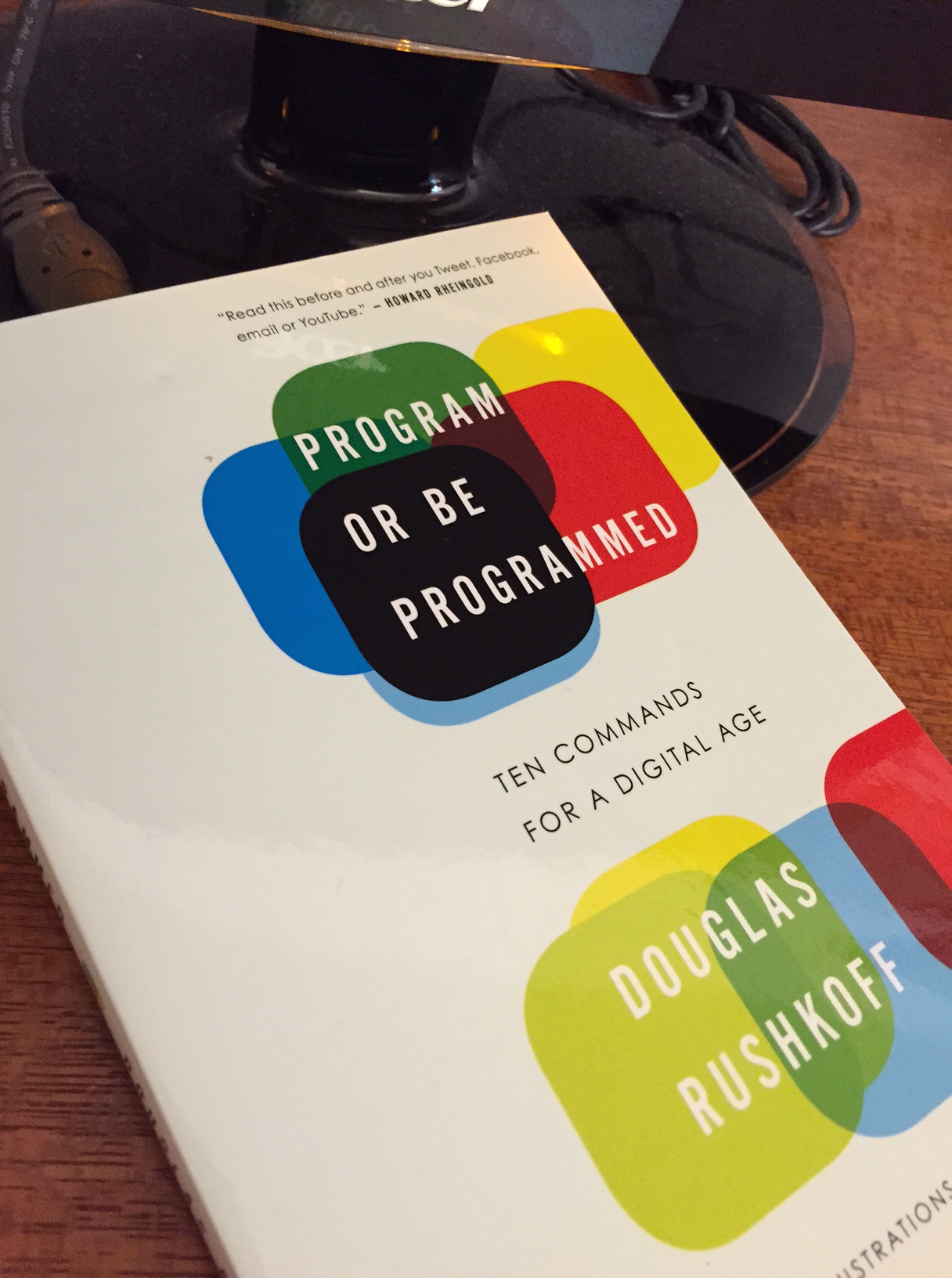
Analyzing the book Program or Be Programmed: Ten Commands for a Digital Age by Douglas Rushkoff
Program or Be Programmed: Ten Commands for a Digital Age by Douglas Rushkoff
Computer literacy is a prerequisite to full participation in digital society. In Program or Be Programmed, Douglas Rushkoff explains why mere computer skills aren’t enough to become a shaper of the future we will live in, or even to influence the present shape of things as they are today. Our lives run in part according to processes and systems driven either wholly or in large part by the way in which software is designed. In both subtle and obvious ways, the choice architecture underpinning processes we participate in every day is guided by unseen hands that programmed how they would work. This happens every time an automated resume screening tool parses data and sifts through applicants before their submission makes contact with a human. It happens when the store of our choice (online or physical) decides what targeted discounts to pitch us for our next visit. It also happens when an algorithm determines search results or when its not-so-distant cousin offers up the next potential life partner or sex buddy via electronic matching services.
None of this is arguably good or bad, but someone’s deliberate thinking made it so. Programs function the way they do by someone’s design. Some of the consequences are intended, while a great many of them aren’t. We can either passively live at the mercy of these important, living operating systems or we can actively shape their design ourselves. But to shape them, we must learn to program or learn enough about programming to influence what gets programmed by others.
One step we can take besides sitting down to learn Python, C++, Swift, or Ruby (which certainly doesn’t hurt) is to study the values of the age of programming. By doing so, we can reset some of the terms by which we live our lives and determine the extent to which technology influences us, our habits, and our value systems. I’ll only focus on a couple here, but all ten of those Rushkoff discusses in Program or Be Programmed are worth considering.
Choice
Digital programs often force binary choices that implicitly limit choices where no such limitation truly exists. Rushkoff rightly points out that we often have a much broader array of choices than the program, bounded by the imaginary limits of its author, offers. And, even more powerfully, we have the power not to choose at all. We can decline a false choice about even such fundamental notions as race, gender, age, political affiliation, or religious belief. Our choices are of our own choosing and need not be determined by programming not of our own making.
Identity
Anonymity comes easy on the Internet. I can present the mask I want people to see. This can cut us off, Rushkoff warns, from being fully present in so much interaction that takes place via digital media. It’s easier to depersonalized and distance myself from the human impact when I don’t face the person. I must claim my identity and bear it openly for my digital communication to mean anything. “Nothing is perfect unless it is personal,” G.K. Chesterton once wrote in The Everlasting Man. Perhaps nothing is perfectly personal, but it must be personal to mean something.
Perhaps an Intention
Humans are the only creatures we know of that participate in their own evolution as a species. Can we do less than participate fully in the design of the programming that shapes the evolution of our culture? Can we do less than apply our personal understanding of the range of choices that ought to be part of the future humankind builds? Can we not see that to get on with programming ourselves is preferable to going along with the program?










 book reading life