For anyone who’s ever had a hellish customer service experience, this is a story for you. You can think of it as a mini tribute to the overworked customer. We’ve all been there at one time or another. We get a product as a gift or sign up for a service. Everything seems to go great at first. Then, disaster strikes. The product fails, the service isn’t what’s expected, or some completely unrelated event renders our purchase unusable. You’re forlorn, left adrift. There’s nowhere to turn. Then it dawns on you that there are people – a whole group of them – who’s sole purpose of existing is helping you navigate the very type of predicament you find yourself in now. They are customer service. You reach out to them, and boy does it not go well.
Benoît Duteurtre plumbs the maddeningly terrible depths of customer service failures in this crisp, hilarious yarn. Our hero in this tale is a decidedly technophobic individual who briefly overcomes his technophobia to embrace his parents’ gift of a smartphone. He is rewarded for his bravery and tolerance with the unfortunate luck of losing his new phone. From there, his life becomes consumed with battling the corporate minions that appear determined to place every obstacle possible between him and accomplishing the goal of replacing his phone. From hold music to internet cafés to waiting rooms to plane trips, the runaround by customer service has him running all over.
This book is more rant than rumination, but it’s fun and relatable. Read this story and it probably won’t change your life. It won’t change your opinion about customer service or the role of tech gadgets in modern life. But I can guarantee you one thing: you will never forget the name Leslie Delmare.
Horatio Alger this bear is not. It isn’t your great grandfather’s rags to riches story when a polar bear becomes a climate refugee and works his way through dead-end jobs as a cub laborer on fishing trawlers, eventually earning enough dough to go wing it in sunny Los Angeles. Having been an actor myself pursuing fame, fortune, and mostly just a way to make a living doing what I loved, the tale of Beaufort the polar bear doing the Hollywood hustle endeared itself to me at the outset. Despite the bad influences of Leonardo DiCaprio and Beaufort’s cokehead Icelandic girlfriend Svava, Beaufort maintains a down home sensibility forged deep in the Artic heartland.
Unfortunately, this sensitive soul of a bear gets ostensibly crushed under the mirage of Hollywood dreams. A familiar story of the downward spiral of celebrity plays out in an often engrossing and sometimes achingly uncomfortable way. Beaufort’s self-absorbed self-destruction has you sympathizing and disgusted with him in turn. Cooper goes to some less than cuddly places with our bear hero’s story. Sexual avarice, addiction, and the aching loss of hope pile higher atop Beaufort than the towering glaciers of his youth stretched up to the sky. He takes professional risks, that while seemingly admirable, are filled with artistic compromises and egoistic obsession.
A move to New York and a genuine submission to the discipline of recovery offer some relief from his anguish. Beaufort begins to approach his art from a place of humility and self-abnegation. He decides to tell the story that is in him to tell. And such is the lesson buried within Cooper’s funny and strange piece about a polar bear who lost his way in more ways than one. We come into our own when we look within ourselves to see the self as God sees it, and look outside ourselves to see the world as God sees it. In doing that, we see what is best in us is what the world needs most from us. What is lacking in us is what the world cannot give. And we need not find it there. Rather, when brokenness and wholeness don’t quite fit together on any given day is when we have to hold still in patience waiting for the pain to pass. Pass it will. For we can’t avoid being wounded, but we can live through our wounds and the living is the balm that heals us.
Beaufort has his sour and petulant moments. He isn’t the most endearing of characters as the story winds on, but he has an outlook that makes the reader want to comprehend the way he experiences the world. Understanding it to be a moderately naïve and charmingly chivalrous optimism that often turns icy before melting afresh into cheerfulness, I – and I dare say the world – could certainly do with a more bearish outlook on life.
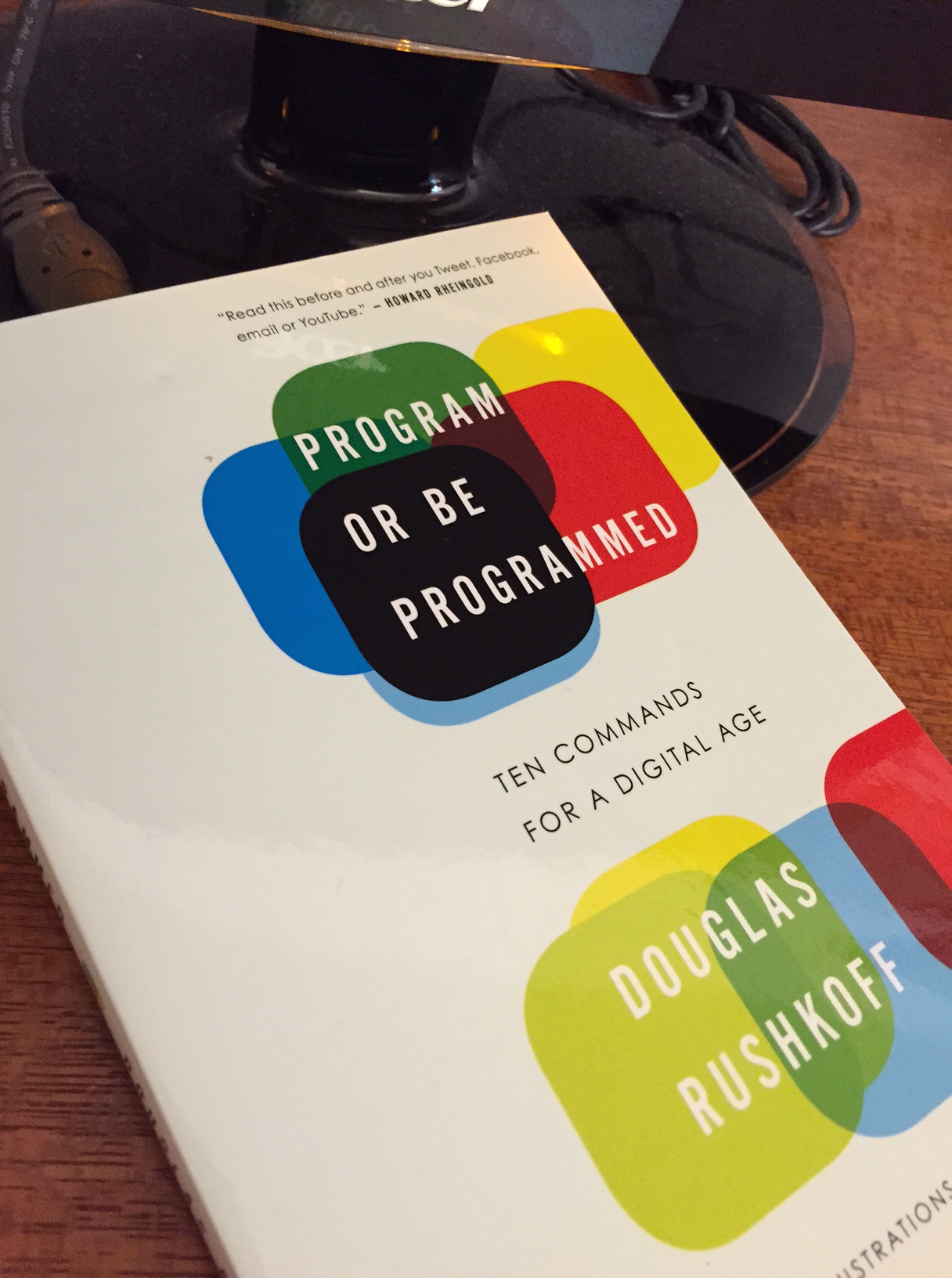
Analyzing the book Program or Be Programmed: Ten Commands for a Digital Age by Douglas Rushkoff
Program or Be Programmed: Ten Commands for a Digital Age by Douglas Rushkoff
Computer literacy is a prerequisite to full participation in digital society. In Program or Be Programmed, Douglas Rushkoff explains why mere computer skills aren’t enough to become a shaper of the future we will live in, or even to influence the present shape of things as they are today. Our lives run in part according to processes and systems driven either wholly or in large part by the way in which software is designed. In both subtle and obvious ways, the choice architecture underpinning processes we participate in every day is guided by unseen hands that programmed how they would work. This happens every time an automated resume screening tool parses data and sifts through applicants before their submission makes contact with a human. It happens when the store of our choice (online or physical) decides what targeted discounts to pitch us for our next visit. It also happens when an algorithm determines search results or when its not-so-distant cousin offers up the next potential life partner or sex buddy via electronic matching services.
None of this is arguably good or bad, but someone’s deliberate thinking made it so. Programs function the way they do by someone’s design. Some of the consequences are intended, while a great many of them aren’t. We can either passively live at the mercy of these important, living operating systems or we can actively shape their design ourselves. But to shape them, we must learn to program or learn enough about programming to influence what gets programmed by others.
One step we can take besides sitting down to learn Python, C++, Swift, or Ruby (which certainly doesn’t hurt) is to study the values of the age of programming. By doing so, we can reset some of the terms by which we live our lives and determine the extent to which technology influences us, our habits, and our value systems. I’ll only focus on a couple here, but all ten of those Rushkoff discusses in Program or Be Programmed are worth considering.
Choice
Digital programs often force binary choices that implicitly limit choices where no such limitation truly exists. Rushkoff rightly points out that we often have a much broader array of choices than the program, bounded by the imaginary limits of its author, offers. And, even more powerfully, we have the power not to choose at all. We can decline a false choice about even such fundamental notions as race, gender, age, political affiliation, or religious belief. Our choices are of our own choosing and need not be determined by programming not of our own making.
Identity
Anonymity comes easy on the Internet. I can present the mask I want people to see. This can cut us off, Rushkoff warns, from being fully present in so much interaction that takes place via digital media. It’s easier to depersonalized and distance myself from the human impact when I don’t face the person. I must claim my identity and bear it openly for my digital communication to mean anything. “Nothing is perfect unless it is personal,” G.K. Chesterton once wrote in The Everlasting Man. Perhaps nothing is perfectly personal, but it must be personal to mean something.
Perhaps an Intention
Humans are the only creatures we know of that participate in their own evolution as a species. Can we do less than participate fully in the design of the programming that shapes the evolution of our culture? Can we do less than apply our personal understanding of the range of choices that ought to be part of the future humankind builds? Can we not see that to get on with programming ourselves is preferable to going along with the program?



 book reading life