Ordinary Perfection

My reflection on Life and Holiness by Thomas Merton

Ordinary perfection and holy humanism aren’t terms that mean much to the modern ears that may hear them. So why, when they sparkle between the lines of Thomas Merton’s Life and Holiness, do they nonetheless have the power to captivate? Perhaps we have a sense that our lives mean more than completing tasks, making money, providing for family and friends, creating art, and speculating about the future. These goals may mean a great deal to us, as they should. Yet, so much of what gives meaning in life also comes from the ordinary, chance encounters with people we know and people we don’t. We have the opportunity to be charitable or not to be, to witness to what we stand for or not to. We can be faithful to what we know to be true or not be. These ordinary choices matter.

Life Holiness Thomas Merton
Life and Holiness by Thomas Merton

Thomas Merton could be referred to as a saint of the unsaintly. He espouses the saintliness of the everyman. And he does it in a way that doesn’t cheapen sainthood. He doesn’t say you’re okay as you are. What he does is simply put sainthood within your grasp as an ordinary person. He says no matter how difficult it is to live a life of honest and pure faith, no one is exempt from the invitation to love. We all have the capacity and the responsibility to love as deeply as we can. Each must serve God and one another in the unique, irreplaceable manner only he or she can. Our lives – all our lives – are pedestals that honor the values we hold dearest or we have ignored the Christian vocation that has stared us in the face since baptism. He makes no bones about the sacrifice involved and the self-discipline required; it’s the ducking out of discipleship he flatly refutes.

Merton makes it clear there isn’t one way to be holy, just as there can’t possibly be only one way to do God’s will. No, God’s will for each of us is as particular to us as it is inescapably ordinary – meaning that it is ordained to apply to everyone. No matter how important society or the organizations we work for may consider us, there is an inner call to holiness that is absolutely direct in relation to us. Religious experiences mediated by the Church and others provide a surely very helpful road; however, the map to spiritual fulfillment is written in some ways more completely on the heart than anywhere else. And so, there are times we must question and challenge established conceptions – soul searching, some call it. Indeed, we hear Merton echo, searching the will of God for us in our souls is precisely the place we ought to look for it.

The type of perfection Merton describes is the ordinary kind, all the more impressive for its achievability. Perfection that exists only as a rarefied aspiration seldom does anyone any real good. Merton’s call to holiness is on the human level. His work of perfection is the everyday diligence that shines through our work life as readily as our spiritual life. we are caretakers of one another, just as we are caretakers of our souls. And it will often be in the ordinary caretaking we do that we get closest to the extraordinary perfection that we seek.
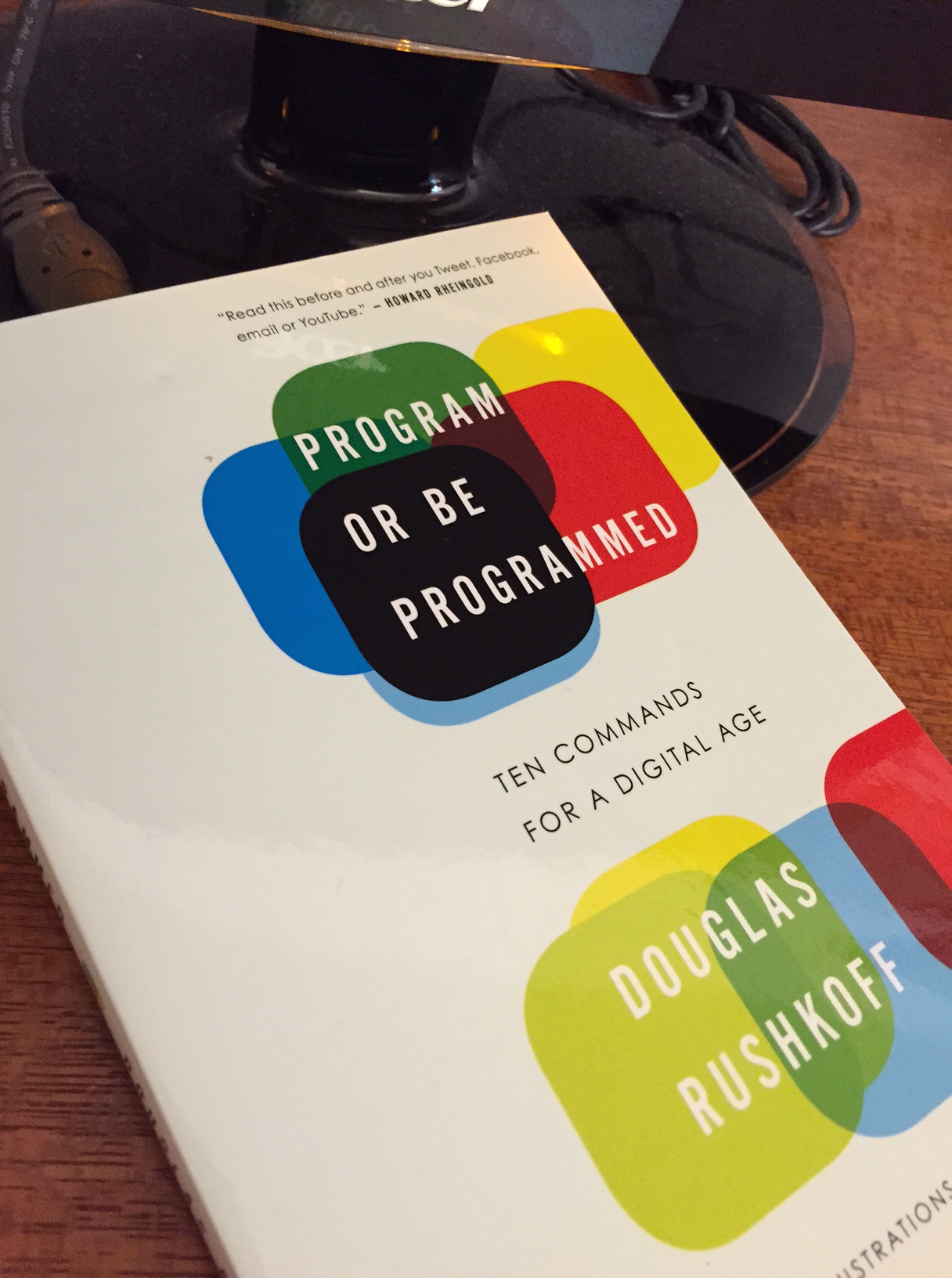
Pro Programming

Analyzing the book Program or Be Programmed: Ten Commands for a Digital Age by Douglas Rushkoff
Program or Be Programmed by Douglas Rushkoff
Program or Be Programmed: Ten Commands for a Digital Age by Douglas Rushkoff

Computer literacy is a prerequisite to full participation in digital society. In Program or Be Programmed, Douglas Rushkoff explains why mere computer skills aren’t enough to become a shaper of the future we will live in, or even to influence the present shape of things as they are today. Our lives run in part according to processes and systems driven either wholly or in large part by the way in which software is designed. In both subtle and obvious ways, the choice architecture underpinning processes we participate in every day is guided by unseen hands that programmed how they would work. This happens every time an automated resume screening tool parses data and sifts through applicants before their submission makes contact with a human. It happens when the store of our choice (online or physical) decides what targeted discounts to pitch us for our next visit. It also happens when an algorithm determines search results or when its not-so-distant cousin offers up the next potential life partner or sex buddy via electronic matching services.

None of this is arguably good or bad, but someone’s deliberate thinking made it so. Programs function the way they do by someone’s design. Some of the consequences are intended, while a great many of them aren’t. We can either passively live at the mercy of these important, living operating systems or we can actively shape their design ourselves. But to shape them, we must learn to program or learn enough about programming to influence what gets programmed by others.

One step we can take besides sitting down to learn Python, C++, Swift, or Ruby (which certainly doesn’t hurt) is to study the values of the age of programming. By doing so, we can reset some of the terms by which we live our lives and determine the extent to which technology influences us, our habits, and our value systems. I’ll only focus on a couple here, but all ten of those Rushkoff discusses in Program or Be Programmed are worth considering.

Choice

Digital programs often force binary choices that implicitly limit choices where no such limitation truly exists. Rushkoff rightly points out that we often have a much broader array of choices than the program, bounded by the imaginary limits of its author, offers. And, even more powerfully, we have the power not to choose at all. We can decline a false choice about even such fundamental notions as race, gender, age, political affiliation, or religious belief. Our choices are of our own choosing and need not be determined by programming not of our own making.

Identity

Anonymity comes easy on the Internet. I can present the mask I want people to see. This can cut us off, Rushkoff warns, from being fully present in so much interaction that takes place via digital media. It’s easier to depersonalized and distance myself from the human impact when I don’t face the person. I must claim my identity and bear it openly for my digital communication to mean anything. “Nothing is perfect unless it is personal,” G.K. Chesterton once wrote in The Everlasting Man. Perhaps nothing is perfectly personal, but it must be personal to mean something.

Perhaps an Intention

Humans are the only creatures we know of that participate in their own evolution as a species. Can we do less than participate fully in the design of the programming that shapes the evolution of our culture? Can we do less than apply our personal understanding of the range of choices that ought to be part of the future humankind builds? Can we not see that to get on with programming ourselves is preferable to going along with the program?