Radical Hospitality

St. Francis Church New Mexico

At its most basic, hospitality means saying “welcome in” to the friend and the stranger alike. This doesn’t mean you share the same intimacy with a stranger as with a friend. It only means you’re open to and grateful for the gift of discovering what any person has to offer no matter who they are. Father Daniel Homan and Lonni Collins Pratt unpack the virtue of hospitality and what it means today in Radical Hospitality: Benedict’s Way of Love. Their interpretation flows from the monastic spirituality of St. Benedict, who in his Rule of St. Benedict set the expectation that monks extend hospitality to others. Hospitality is for everyone, not just monks. While hospitality has become associated with hotels, tourism, and the business of keeping people entertained, the authors explain that it is about relationships. Hospitality expresses itself in relationships that start with gratefulness for the gift of encountering someone else instead of mistrust, suspicion, or – worst of all – the desire to use another as an instrument to our ends.

Radical Hospitality Homan and Pratt
Radical Hospitality: Benedict’s Way of Love


Stories abound in  holy texts, especially those passed on by desert people (like the Bible or the Qur’an), of the importance of hospitality. It was a life or death matter for travelers in earlier eras. And in many parts of the world or in the case of refugees fleeing their home countries, it is still a matter of life and death today. Even outside of these dire circumstances, the spirit of hospitality calls us to a more authentic way of relating to each other. We can choose to see in other people a grace that we admire, a skill we share, or a virtue we seek. So often when we search for the good in others, we find it in ourselves. When we focus on the evil, it appears in us too. Perhaps in learning hospitality toward others, we learn to live with ourselves. We learn to accept our faults when we can more tolerably overlook the faults of our fellow travelers. Through hospitality, we learn the courage to be kind – both to ourselves and those very different from us.

Even as we create a more technologically advanced world, we need to make it hospitable. We need to make it a fit place for spiritual beings to reside in. Sending an email, joining a video conference, or posting on someone’s website are the new ways we sometimes welcome others into our home or enter as strangers into someone else’s. Technology makes us more accessible to each other through communication tools. Consequently, we have to make sure that when we access each other we do so in a way that is humane and hospitable. Sending and receiving information has never been so easy, but it has probably never been so difficult to maintain the level of hospitality required. I am grateful to Homan and Pratt for the depth of their study of hospitality and the accessible way in which they communicate it in Radical Hospitality. At its most basic, hospitality means saying “welcome in”- easier to say about your house than about your heart.
 

Popular Genius

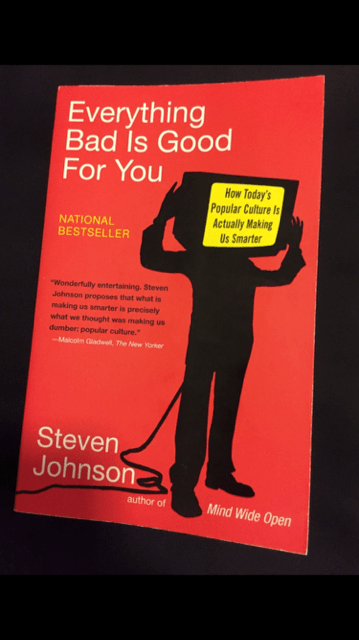
Everything Bad Is Good For You

Contrary to popular belief, popular culture isn’t dumbing down concepts or reducing us to piles of mashed couch potato. Television programs and video games engage modern audiences in ways that deepen cognitive capacity. Steven Johnson writes, “The story of the last thirty years of popular culture is the story of rising complexity and increased cognitive demands.” Everything Bad is Good for You is a heartening take on popular culture that runs counter to accepted wisdom. People have long argued that modern games and media are both riddled with sex and violence, and devoid of edifying content. Not so, claims Johnson. In one illustration, Johnson maps out the family tree in the show Dallas and compares it to intricate web of characters and families in 24. It’s not even close how much more complex the interlocking relationships of 24 are. When it comes to plot, there might be layers that are introduced and go unexplored for a few episodes before they are brought back again as crucial elements. Often modern shows will pick up the thread instantaneously without explanation or preamble and viewers are expected to follow nimbly along.

Everything Bad Is Good For You
Everything Bad Is Good For You by Steven Johnson

Johnson goes out of his way to point out that not all TV shows and video games are alike. While many of the award-winning titles that media critics decry as slop do enhance our cognitive powers, others provide empty calories. It isn’t a particular format, like cable drama or reality show, that makes the difference. Rather, it’s more about the complexity of the personalities, plot developments, and volume of interdependent threads of the story that makes the difference. One can make an expertly crafted police drama or an intellectually impoverished documentary. The cognitive payoff depends on the investment the creator demands of the audience.

The same holds true for video games. Often derided as a time-wasting activity, Johnson argues that many games make their players smarter. He contends that games are actually an incredibly practical way of learning the scientific method. Players don’t just passively absorb the plot or unfolding levels of a good game. Players probe, explore, hypothesize, and experiment their way to success. They have to learn the physical and social laws of new worlds. They have to test and retest boundaries. They have to interpret the results and make consequential choices based upon their interpretations. They get real-time feedback about when they have guessed rightly or wrongly. Sometimes it’s not even clear what the expected outcome of a game is or what success actually looks like. You have to figure that out for yourself as you go. What better preparation for life as a 21st century knowledge worker could there be?

Bearish Outlook

The Beaufort Diaries by T Cooper
Beaufort Diaries
The Beaufort Diaries by T Cooper

Horatio Alger this bear is not. It isn’t your great grandfather’s rags to riches story when a polar bear becomes a climate refugee and works his way through dead-end jobs as a cub laborer on fishing trawlers, eventually earning enough dough to go wing it in sunny Los Angeles. Having been an actor myself pursuing fame, fortune, and mostly just a way to make a living doing what I loved, the tale of Beaufort the polar bear doing the Hollywood hustle endeared itself to me at the outset. Despite the bad influences of Leonardo DiCaprio and Beaufort’s cokehead Icelandic girlfriend Svava, Beaufort maintains a down home sensibility forged deep in the Artic heartland.

Unfortunately, this sensitive soul of a bear gets ostensibly crushed under the mirage of Hollywood dreams. A familiar story of the downward spiral of celebrity plays out in an often engrossing and sometimes achingly uncomfortable way. Beaufort’s self-absorbed self-destruction has you sympathizing and disgusted with him in turn. Cooper goes to some less than cuddly places with our bear hero’s story. Sexual avarice, addiction, and the aching loss of hope pile higher atop Beaufort than the towering glaciers of his youth stretched up to the sky. He takes professional risks, that while seemingly admirable, are filled with artistic compromises and egoistic obsession.

A move to New York and a genuine submission to the discipline of recovery offer some relief from his anguish. Beaufort begins to approach his art from a place of humility and self-abnegation. He decides to tell the story that is in him to tell. And such is the lesson buried within Cooper’s funny and strange piece about a polar bear who lost his way in more ways than one. We come into our own when we look within ourselves to see the self as God sees it, and look outside ourselves to see the world as God sees it. In doing that, we see what is best in us is what the world needs most from us. What is lacking in us is what the world cannot give. And we need not find it there. Rather, when brokenness and wholeness don’t quite fit together on any given day is when we have to hold still in patience waiting for the pain to pass. Pass it will. For we can’t avoid being wounded, but we can live through our wounds and the living is the balm that heals us.

Beaufort has his sour and petulant moments. He isn’t the most endearing of characters as the story winds on, but he has an outlook that makes the reader want to comprehend the way he experiences the world. Understanding it to be a moderately naïve and charmingly chivalrous optimism that often turns icy before melting afresh into cheerfulness, I – and I dare say the world – could certainly do with a more bearish outlook on life.

Pro Programming

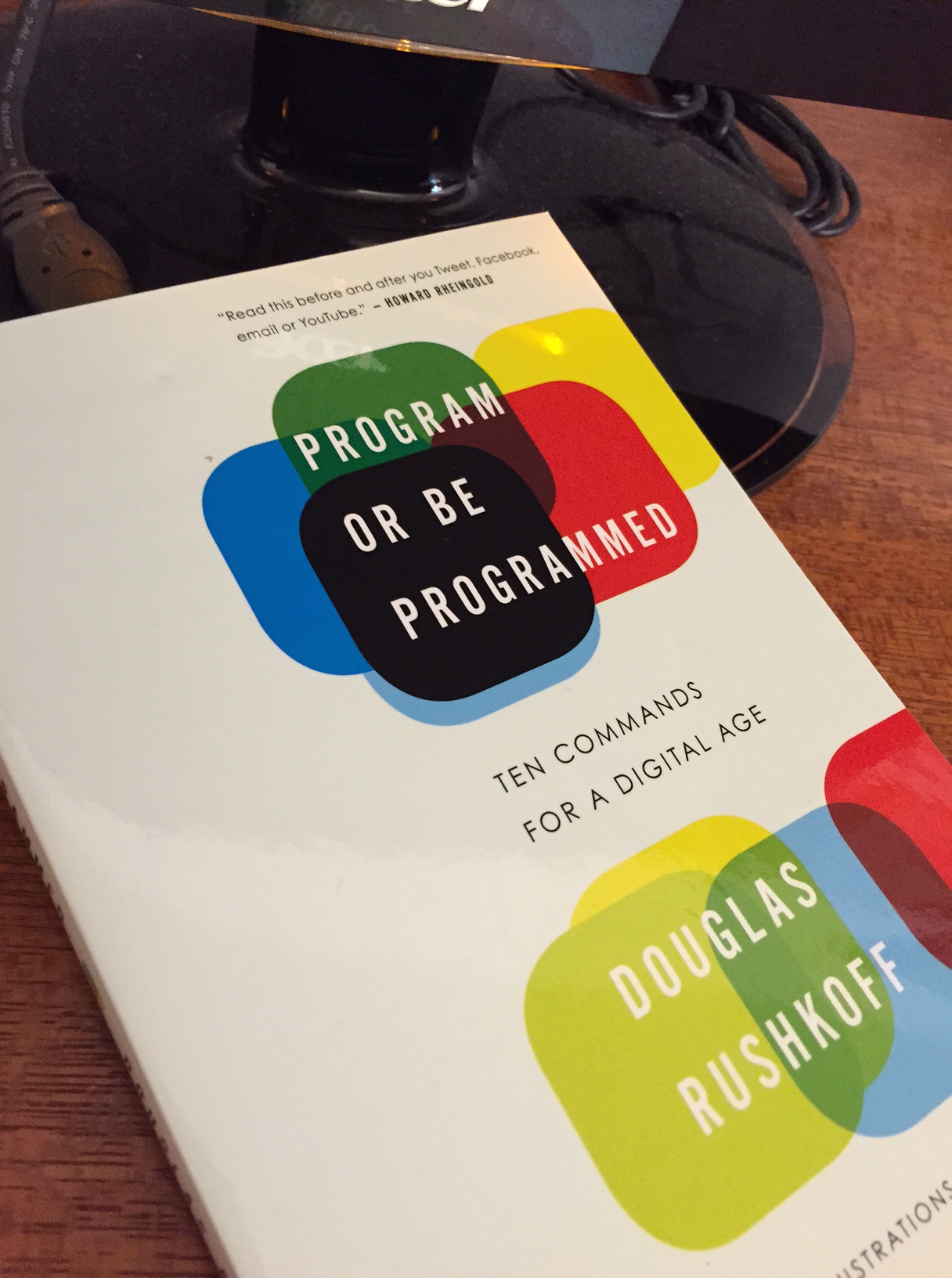
Analyzing the book Program or Be Programmed: Ten Commands for a Digital Age by Douglas Rushkoff
Program or Be Programmed by Douglas Rushkoff
Program or Be Programmed: Ten Commands for a Digital Age by Douglas Rushkoff

Computer literacy is a prerequisite to full participation in digital society. In Program or Be Programmed, Douglas Rushkoff explains why mere computer skills aren’t enough to become a shaper of the future we will live in, or even to influence the present shape of things as they are today. Our lives run in part according to processes and systems driven either wholly or in large part by the way in which software is designed. In both subtle and obvious ways, the choice architecture underpinning processes we participate in every day is guided by unseen hands that programmed how they would work. This happens every time an automated resume screening tool parses data and sifts through applicants before their submission makes contact with a human. It happens when the store of our choice (online or physical) decides what targeted discounts to pitch us for our next visit. It also happens when an algorithm determines search results or when its not-so-distant cousin offers up the next potential life partner or sex buddy via electronic matching services.

None of this is arguably good or bad, but someone’s deliberate thinking made it so. Programs function the way they do by someone’s design. Some of the consequences are intended, while a great many of them aren’t. We can either passively live at the mercy of these important, living operating systems or we can actively shape their design ourselves. But to shape them, we must learn to program or learn enough about programming to influence what gets programmed by others.

One step we can take besides sitting down to learn Python, C++, Swift, or Ruby (which certainly doesn’t hurt) is to study the values of the age of programming. By doing so, we can reset some of the terms by which we live our lives and determine the extent to which technology influences us, our habits, and our value systems. I’ll only focus on a couple here, but all ten of those Rushkoff discusses in Program or Be Programmed are worth considering.

Choice

Digital programs often force binary choices that implicitly limit choices where no such limitation truly exists. Rushkoff rightly points out that we often have a much broader array of choices than the program, bounded by the imaginary limits of its author, offers. And, even more powerfully, we have the power not to choose at all. We can decline a false choice about even such fundamental notions as race, gender, age, political affiliation, or religious belief. Our choices are of our own choosing and need not be determined by programming not of our own making.

Identity

Anonymity comes easy on the Internet. I can present the mask I want people to see. This can cut us off, Rushkoff warns, from being fully present in so much interaction that takes place via digital media. It’s easier to depersonalized and distance myself from the human impact when I don’t face the person. I must claim my identity and bear it openly for my digital communication to mean anything. “Nothing is perfect unless it is personal,” G.K. Chesterton once wrote in The Everlasting Man. Perhaps nothing is perfectly personal, but it must be personal to mean something.

Perhaps an Intention

Humans are the only creatures we know of that participate in their own evolution as a species. Can we do less than participate fully in the design of the programming that shapes the evolution of our culture? Can we do less than apply our personal understanding of the range of choices that ought to be part of the future humankind builds? Can we not see that to get on with programming ourselves is preferable to going along with the program?