Close to Home

Face Mountain Sun

I’ve heard the phrase “too close to home” more in the last few days than I pray I ever will again. My wife and I live in Redlands, CA. She works at a nonprofit in San Bernardino down the street from the center where the recent mass shooting took place. I work in Redlands near the neighborhood where the shooters’ apartment stocked with weaponry was discovered. The shooting rocked our community, our sense of safety, and our sense of being at home. The fact that it may in part have been designed to do just that makes it worse. The fact that the killers are dead gives us no solace. Only our friends, family, coworkers, neighbors, and love for one another can provide that.

The person and the place you call home is determined most by bonds of love and generosity. Much less by the things we oppose, and even less still by what we hate. And hate we sometimes will – because the hateful and the repulsive will always be with us. But our hatred doesn’t define us; it doesn’t make us powerful. Only our love can do that. It’s not just what makes us feel safe and at home. It’s the only thing that ever has.

When watching the news release the names of the shooters, our hearts sank. We feared the killers might be identified as Muslims and that this might bring a fresh wave of inhumane hatred with their act of inhumanity. It’s a double crime to betray your community with horrific violence and at the same time corrupt the names of good and peaceful religious people who are among the creative citizens who call America their home. Such an act does violence to truth as well as to flesh and blood.

We have personal as well as social reasons to fear. My wife is Muslim and I am Catholic. We met 8 years ago and got married for the first time nearly two years ago. I say “for the first time” because we were married three times to each other – once civilly (and within 90 days of legal entry) in accordance with American law, once in accordance with Islam, and once in accordance with the Catholic Church. We’ve made an art of reconciling requirements, statutes, and limitations, and turning them into a beautiful journey we can share together on our way to creating a life of joy and family and service to others.

Is ours a story of immigration, of interfaith union, of overcoming odds and obstacles? Maybe it is, but that’s not how we see it. To us, ours is a love story like any other. Have we encountered bigotry and unintentional insult? Yes. Do we live in a safe world? Sometimes it is and sometimes it’s not. Do we live in a world that supports our most glorious aspirations or one that’s hostile to our  deeply held dreams? Both. What about the country we call home? It often lives up to its reputation and sometimes it falls short. Does any of this paralyze us? Almost never.

And neither will the mass shooting here in San Bernardino. The day after the shooting, people lined up at a local blood bank down the street from the building where the shooting happened to donate blood for the victims. We’re a people that literally bleed for each other when one of us is in trouble. That’s a beautiful thing and something that greatly pleases the God who made us, no matter by what name we address Her or by what prophet He speaks to us.

Much will be said about things we should do to make it more difficult for people to commit acts of mass murder like the one that happened here. We should talk about those things and we should do more to prevent these acts. But we should also do more to foster communities of hospitality, respect, and resilience. We should do more to be a haven for refugees, immigrants, and the poor. We should do more to live up to our highest ideals and not lower our standards in the interests of  self-interest and self-protection. In the end, that doesn’t make us safer – only smaller.

Many and specific will be the calls to respond. And if we must respond to extremism in the extreme, let it be thus: to extend friendship with those different from us, to welcome the stranger from foreign lands, to give when we haven’t enough ourselves, to learn more about the people we find most difficult to understand, to serve one another when it makes us most uncomfortable, and to forgive when we would rather take vengeance. At this time, I’m reminded of the words of a Jesuit priest who spoke at mass on the day of my Georgetown graduation. While I don’t remember his name, his words I’ll never forget. He said, “The quality of your life will be determined by the quality of your loving.” No words I’ve heard feel truer to me now than these.

In the final analysis, it isn’t so much a matter of avoiding or preventing evil in this world. Evil will never be wholly overcome short of the next life. Rather, we must overcome our own impulse to despair – what Kierkegaard called the “sickness unto death” – and give over as much of ourselves to love and serving the Good as there remains in us to be offered. This is the holy sacrifice. This is the spotless victory.


Face Mountain Sun
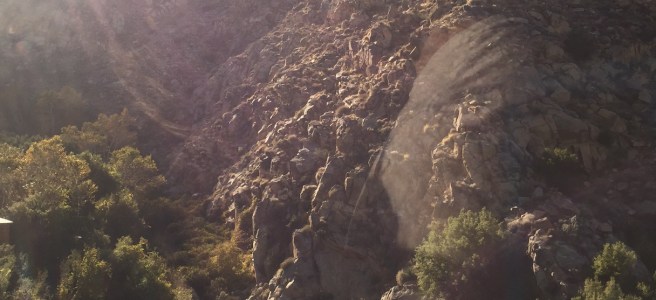
Face in the Mountain in the Sun

Bearish Outlook

The Beaufort Diaries by T Cooper
Beaufort Diaries
The Beaufort Diaries by T Cooper

Horatio Alger this bear is not. It isn’t your great grandfather’s rags to riches story when a polar bear becomes a climate refugee and works his way through dead-end jobs as a cub laborer on fishing trawlers, eventually earning enough dough to go wing it in sunny Los Angeles. Having been an actor myself pursuing fame, fortune, and mostly just a way to make a living doing what I loved, the tale of Beaufort the polar bear doing the Hollywood hustle endeared itself to me at the outset. Despite the bad influences of Leonardo DiCaprio and Beaufort’s cokehead Icelandic girlfriend Svava, Beaufort maintains a down home sensibility forged deep in the Artic heartland.

Unfortunately, this sensitive soul of a bear gets ostensibly crushed under the mirage of Hollywood dreams. A familiar story of the downward spiral of celebrity plays out in an often engrossing and sometimes achingly uncomfortable way. Beaufort’s self-absorbed self-destruction has you sympathizing and disgusted with him in turn. Cooper goes to some less than cuddly places with our bear hero’s story. Sexual avarice, addiction, and the aching loss of hope pile higher atop Beaufort than the towering glaciers of his youth stretched up to the sky. He takes professional risks, that while seemingly admirable, are filled with artistic compromises and egoistic obsession.

A move to New York and a genuine submission to the discipline of recovery offer some relief from his anguish. Beaufort begins to approach his art from a place of humility and self-abnegation. He decides to tell the story that is in him to tell. And such is the lesson buried within Cooper’s funny and strange piece about a polar bear who lost his way in more ways than one. We come into our own when we look within ourselves to see the self as God sees it, and look outside ourselves to see the world as God sees it. In doing that, we see what is best in us is what the world needs most from us. What is lacking in us is what the world cannot give. And we need not find it there. Rather, when brokenness and wholeness don’t quite fit together on any given day is when we have to hold still in patience waiting for the pain to pass. Pass it will. For we can’t avoid being wounded, but we can live through our wounds and the living is the balm that heals us.

Beaufort has his sour and petulant moments. He isn’t the most endearing of characters as the story winds on, but he has an outlook that makes the reader want to comprehend the way he experiences the world. Understanding it to be a moderately naïve and charmingly chivalrous optimism that often turns icy before melting afresh into cheerfulness, I – and I dare say the world – could certainly do with a more bearish outlook on life.

Sight Unseen

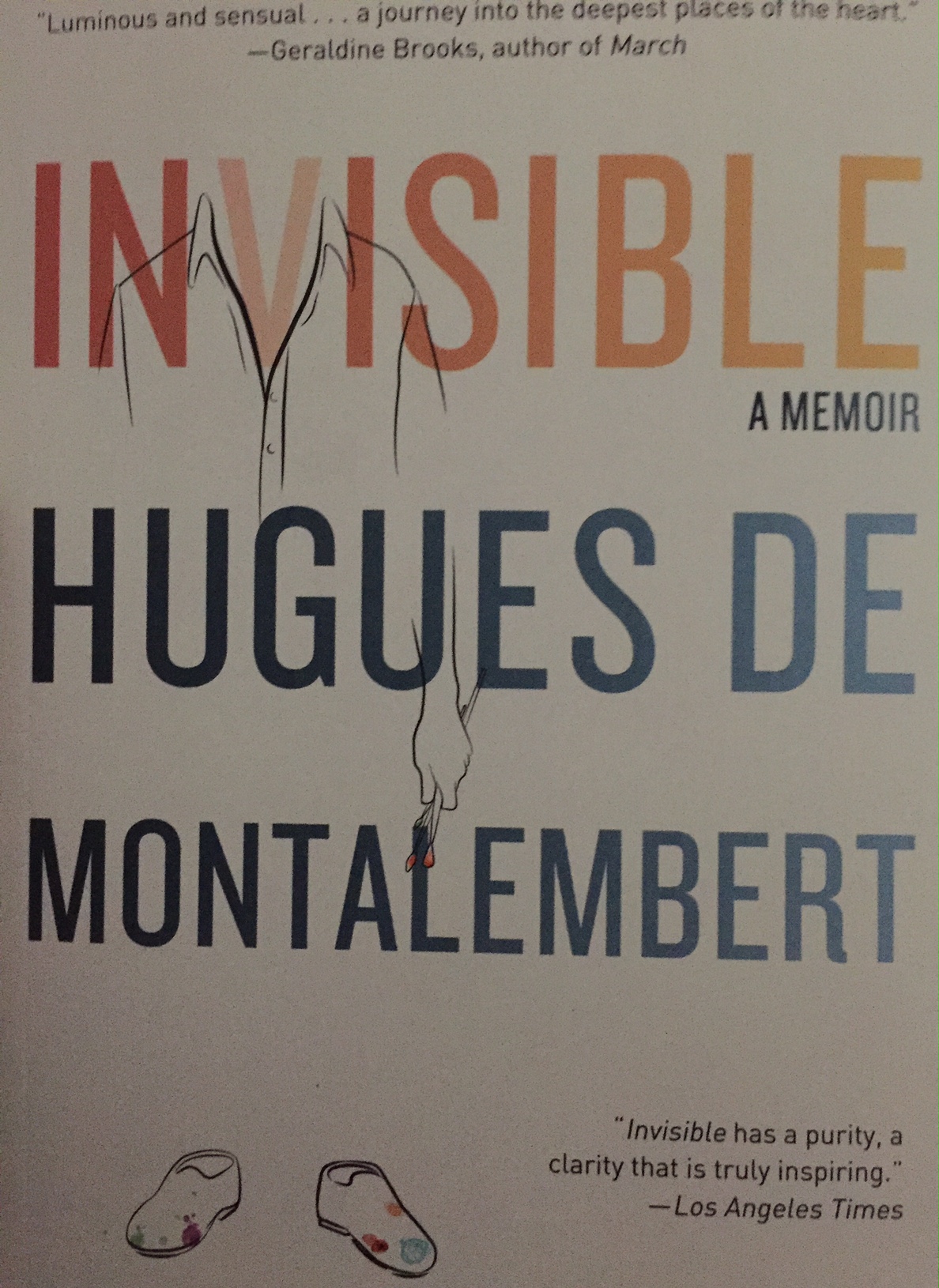
Invisible: A Memoir by Hugues de Montalembert
Invisible Book
Invisible: A Memoir by Hugues de Montalembert

Sight, like all senses, is seldom savored except in its absence. What it means to go suddenly and inescapably blind is the subject of Invisible by Hugues de Montalembert. One night Hugues loses his sight at the hands of criminals who invade his home. A painter and filmmaker, Hugues wakes in a hospital the next day to find he’s bereft of the sense most useful to him as a visual artist. Almost as though it’s trying to compensate, his brain tries to replace the lost vision with images cobbled together from memory and the faintest of visual stimuli. Even when sight is diminished to nothing, our minds seek meaning from the glimmers between shadows. But when despair would strike, a darkness of the mind clouded everything. I got the sense it was the inner confrontation rather than the external limitations on the physical senses that zapped the bulk of de Montalembert’s energy as he works to recreate his changed life.

Searching for meaning is as core a part of this book as it is a core part of human life. The searching takes on a different character and urgency as a result of the sudden blindness, but the search itself is universal. We are either helped or hindered by the personal resources we have to invest in the search, as well as the energy we put in. When we bump up against boundaries and limits that discourage us, we have to seek a way to overcome them. Hugues fights fiercely for independence and pushes the limits imposed by caregivers, medical experts, blind peers, and his own psyche. His struggle may echo setbacks we’ve experienced and from which, even though we may recover, we are never the same again. And nor would we spend much time desiring that if we want to improve our situation. Pragmatism wins out to prevent emotional collapse.

Ultimately, it’s a radical move that saves the author. He travels across the world alone. Never more fearful, he departs his home to see the world from his new vantage point. Venturing into the unknown, the known comes into sharper relief. Ingenuity comes out of necessity. Learning goes faster because the hurdles come quicker with no hiding place or comfort zone to retreat to. The author describes writing so long his pen runs out of ink and of course he doesn’t know it when it happens. He writes a whole day with no ink. He has nothing to show for his day’s work, but he had written the words and formed the thoughts by his own hand. Writing it is, even if no writing is left behind.

What constitutes “seeing” and what constitutes “not seeing”? “Vision is a creation,” Hugues writes. Based on that, the meaning of seeing remains invisible and we can only know it when we see it – when we see. Not so with not seeing. Seeing only what is readily apparent at first sight is the same as not to see.

Doubt Faithfully

Reflecting on Between the Daylight and the Dark: Embracing the Contradictions of Life by Joan Chittister

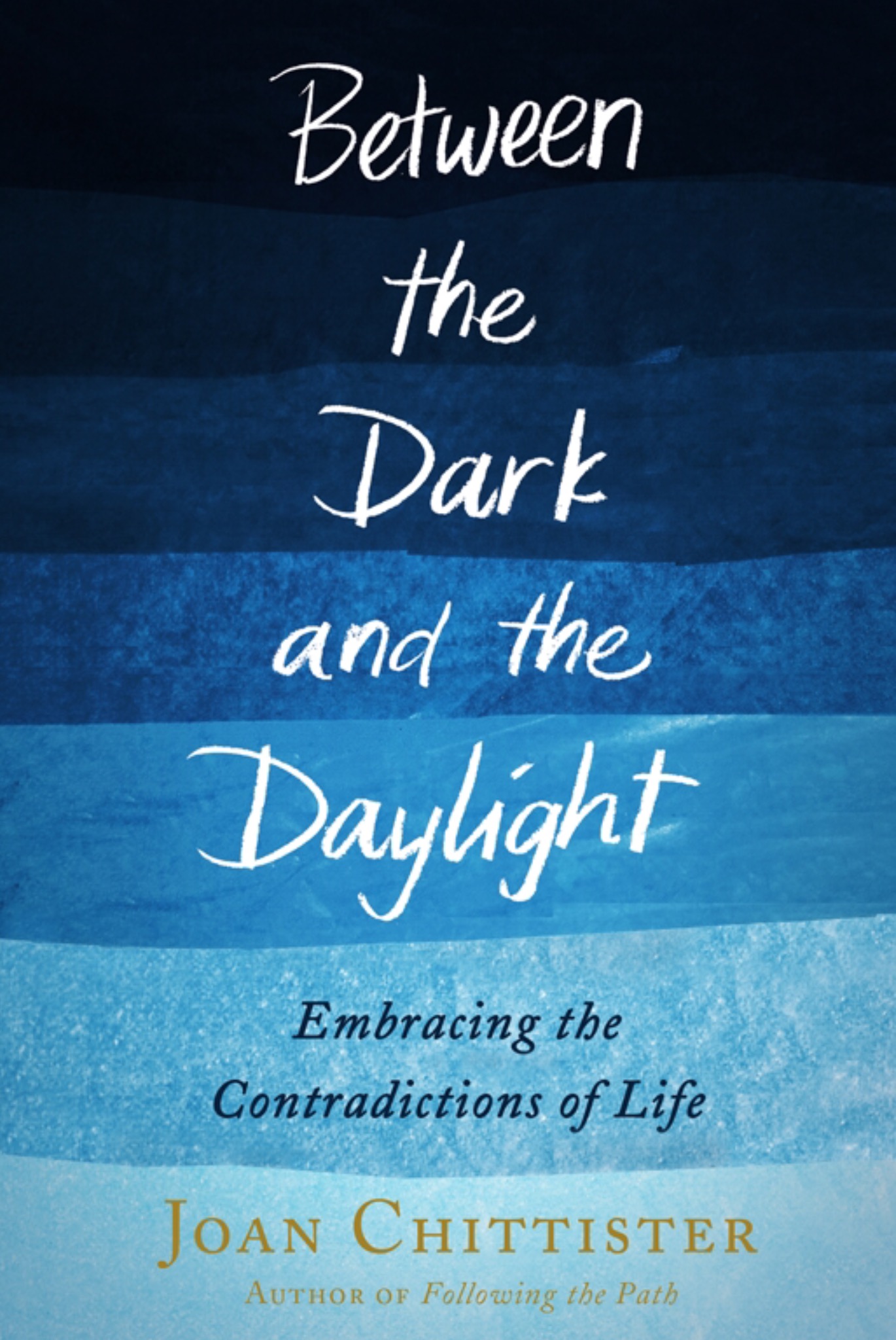
Paradox and contradiction permeate life. That which we need for growth in the spiritual life is nearly always uncomfortable or disconcerting. When life knocks us off-balance, we ultimately find a surer footing and a deeper harmony as a result. Most of us want to avoid these situations, but we strive against that impulse, push outside our comfort zones, and aim for expanding our horizons despite the temporary growth pains. In a series of short chapters, Joan Chittister illuminates this paradox among many others we encounter on life’s spiritual journey. A perfect companion for Lent, this volume is magnetic in its simplicity. Sketching the contours of each contradiction, Joan’s reflections remove some of the fear we feel in these situations and grant us a share of her courage.

Between the Dark and the Daylight: Embracing the Contradictions of Life by Joan Chittister

Doubt isn’t something that usually shows up in any list of important virtues. Neither is uncertainty. Chittister challenges us to see these “negative” perspectives as something more than things to be overcome. Rather, they are to be embraced. Before knowledge, she would argue, comes confusion. The mind becomes clouded before the clouds can lift to reveal the light of understanding. There is no arrival at one’s destination without the first unsure steps. Those steps aren’t something to hurry through or get over with as quickly as possible, but they’re to be actively experienced for what they are if we want to drink fully the marrow of life.

Darkness haunts all of us in terribly personal and individual ways. None of us have the same sins, vices, or transgressions against others. We run from our shadows. They frighten us all the more for having our shape. Evil, it seems, is as particular as goodness. Acknowledging and relating to the shadow side of the self affords us opportunities for change. Joan’s descriptions of this change, though, bring out the quality of conversion of heart. We often think of life-changing experiences as moments of clarity, religious visions, or dramatic experiences that alter our lives in a single instant. While these types of changes do happen, most change is gradual. It takes place incrementally over the course of days, months, and years. Rooted in the heart, these changes are no less important for their gradual evolution over time. In many cases, we make more diligent spiritual progress by faithful repetition and loving discipline than by trying to artificially generate ecstatic leaps forward. Enlightenment happens on God’s terms not on ours.

Anyone who meditates or practices a form of contemplative prayer understands this firsthand. It isn’t always doing but sometimes not-doing that moves us further along the way. Indeed, the whole concept of a set path or a defined distance we must travel to God collapses when it becomes clear that life isn’t linear at all. We connect to people, ideas, and the natural world in a web of strands – each having its own purpose, leading where it must go, and holding for a moment the will of the Divine for us. Some of these connections will outlast us and others may not, but they’ll have served their purpose and thereby served us well in any case.

Some questions never resolve themselves, not in this life anyway. The discovery Joan helps us make, and it is one I feel I must continually rediscover year after year, is that this is how it should be. We haven’t failed in life if questions persist. Anxiety, like the poor, will always be with us. There’s nothing wrong with not knowing the answers to life’s deepest questions beyond the shadow of doubt. The only problem is when we cease to ask them altogether.