
Popular Genius

Everything Bad Is Good For You

Contrary to popular belief, popular culture isn’t dumbing down concepts or reducing us to piles of mashed couch potato. Television programs and video games engage modern audiences in ways that deepen cognitive capacity. Steven Johnson writes, “The story of the last thirty years of popular culture is the story of rising complexity and increased cognitive demands.” Everything Bad is Good for You is a heartening take on popular culture that runs counter to accepted wisdom. People have long argued that modern games and media are both riddled with sex and violence, and devoid of edifying content. Not so, claims Johnson. In one illustration, Johnson maps out the family tree in the show Dallas and compares it to intricate web of characters and families in 24. It’s not even close how much more complex the interlocking relationships of 24 are. When it comes to plot, there might be layers that are introduced and go unexplored for a few episodes before they are brought back again as crucial elements. Often modern shows will pick up the thread instantaneously without explanation or preamble and viewers are expected to follow nimbly along.
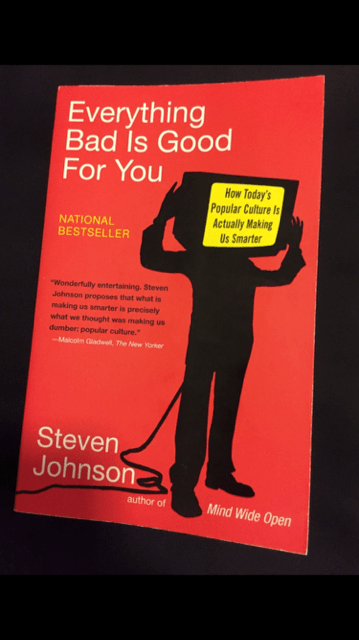
Everything Bad Is Good For You
Everything Bad Is Good For You by Steven Johnson

Johnson goes out of his way to point out that not all TV shows and video games are alike. While many of the award-winning titles that media critics decry as slop do enhance our cognitive powers, others provide empty calories. It isn’t a particular format, like cable drama or reality show, that makes the difference. Rather, it’s more about the complexity of the personalities, plot developments, and volume of interdependent threads of the story that makes the difference. One can make an expertly crafted police drama or an intellectually impoverished documentary. The cognitive payoff depends on the investment the creator demands of the audience.

The same holds true for video games. Often derided as a time-wasting activity, Johnson argues that many games make their players smarter. He contends that games are actually an incredibly practical way of learning the scientific method. Players don’t just passively absorb the plot or unfolding levels of a good game. Players probe, explore, hypothesize, and experiment their way to success. They have to learn the physical and social laws of new worlds. They have to test and retest boundaries. They have to interpret the results and make consequential choices based upon their interpretations. They get real-time feedback about when they have guessed rightly or wrongly. Sometimes it’s not even clear what the expected outcome of a game is or what success actually looks like. You have to figure that out for yourself as you go. What better preparation for life as a 21st century knowledge worker could there be?

Bearish Outlook

The Beaufort Diaries by T Cooper
Beaufort Diaries
The Beaufort Diaries by T Cooper

Horatio Alger this bear is not. It isn’t your great grandfather’s rags to riches story when a polar bear becomes a climate refugee and works his way through dead-end jobs as a cub laborer on fishing trawlers, eventually earning enough dough to go wing it in sunny Los Angeles. Having been an actor myself pursuing fame, fortune, and mostly just a way to make a living doing what I loved, the tale of Beaufort the polar bear doing the Hollywood hustle endeared itself to me at the outset. Despite the bad influences of Leonardo DiCaprio and Beaufort’s cokehead Icelandic girlfriend Svava, Beaufort maintains a down home sensibility forged deep in the Artic heartland.

Unfortunately, this sensitive soul of a bear gets ostensibly crushed under the mirage of Hollywood dreams. A familiar story of the downward spiral of celebrity plays out in an often engrossing and sometimes achingly uncomfortable way. Beaufort’s self-absorbed self-destruction has you sympathizing and disgusted with him in turn. Cooper goes to some less than cuddly places with our bear hero’s story. Sexual avarice, addiction, and the aching loss of hope pile higher atop Beaufort than the towering glaciers of his youth stretched up to the sky. He takes professional risks, that while seemingly admirable, are filled with artistic compromises and egoistic obsession.

A move to New York and a genuine submission to the discipline of recovery offer some relief from his anguish. Beaufort begins to approach his art from a place of humility and self-abnegation. He decides to tell the story that is in him to tell. And such is the lesson buried within Cooper’s funny and strange piece about a polar bear who lost his way in more ways than one. We come into our own when we look within ourselves to see the self as God sees it, and look outside ourselves to see the world as God sees it. In doing that, we see what is best in us is what the world needs most from us. What is lacking in us is what the world cannot give. And we need not find it there. Rather, when brokenness and wholeness don’t quite fit together on any given day is when we have to hold still in patience waiting for the pain to pass. Pass it will. For we can’t avoid being wounded, but we can live through our wounds and the living is the balm that heals us.

Beaufort has his sour and petulant moments. He isn’t the most endearing of characters as the story winds on, but he has an outlook that makes the reader want to comprehend the way he experiences the world. Understanding it to be a moderately naïve and charmingly chivalrous optimism that often turns icy before melting afresh into cheerfulness, I – and I dare say the world – could certainly do with a more bearish outlook on life.