
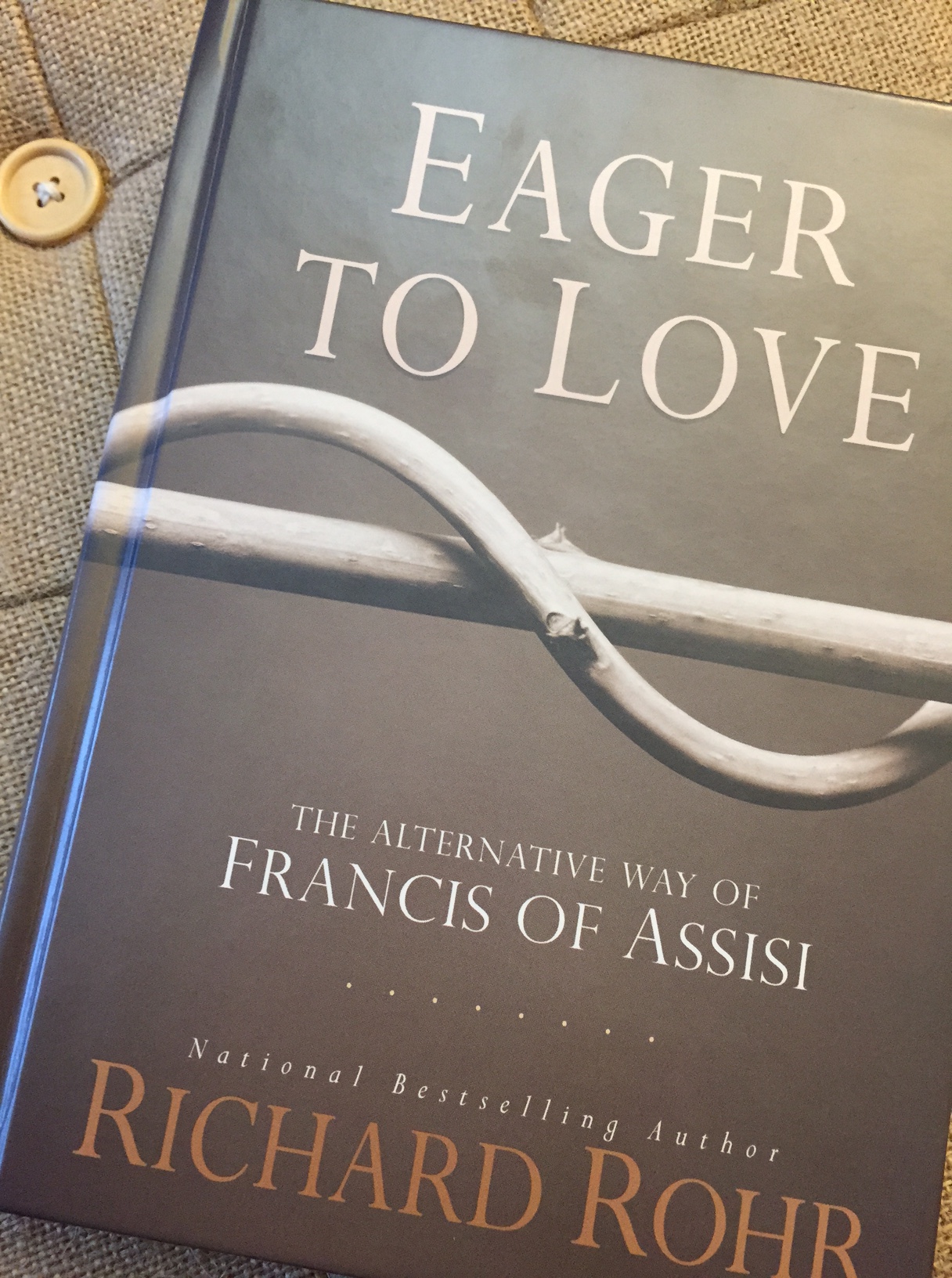
Reflecting on Eager to Love: The Alternative Way of Francis of Assisi by Richard Rohr
In an age with dating services like Ashley Madison, people seem to crave love, sex, and intimacy without risk. And yet, to love someone without the willingness to risk anything is a shriveled and shrunken kind of love. To love without risk to the self is not only cowardly, but not really even love at all. If love involves placing another before oneself, this kind of self-centered love that characterizes our age is more akin to mutual vanity – like two people sitting across from one another, each looking
in a mirror. The illusion of mutuality is there, but love is surely not.
Nothing could be further from the love that shone forth from St. Francis. His was a love that took vulnerability to a level of Christ-like magnanimity. So overflowing and energetic was his love that I think it would be difficult for us moderns to recognize it. If exhibited today by a stranger or even a friend, we might mistake it for something contrived. Certainly, we would think, such love as this is much too raw to be real. It’s too faithful to be believed. It can’t possibly be authentic. Such is our depravity that we would mistake the naked face of love for a mask.
Richard Rohr does a tremendous job bringing the texture of Franciscan love alive for the contemporary reader. Rather than use Francis as a prop for some social or political thesis, Rohr places Francis before the reader and then surrounds him with the people, concepts, images, and experiences that all bear the mark of this saint’s particular manner of living. St. Bonaventure, John Duns Scotus, Pope Francis, and St. Clare contribute to Christianity in no small way and in no way without their relationship to Francis. Each influenced and was influenced by the Franciscan spirit. Francis’s way of relating to God through contemplation and simplicity constitutes less of a “path” or spiritual school of thought, and more of a disposition of heart.
The Franciscan way of downward mobility runs counter to notions of success in society as much in this age as in the age in which Francis lived, but Francis and his spiritual partner, Clare, resided outside systems and inside an ethic of service. The gift of their poverty was generosity. The more they renounced, the more they had to bestow. St. Francis and St. Clare together transcribe the teachings of Jesus, not with ink but with action. It always seemed odd to me that St. Clare would serve as the patron of television, a medium for which I always thought she’d have little use if she were alive today. Now I think that it’s the fact she’d have no need of it that makes her its perfect patron. Like love, it’s best when a screen isn’t something we turn on so as not to feel alone. Like love, media serves us better when it’s something we don’t consume lest it consume us in the process. Like love, it serves a higher aim than self-stimulation or it only serves to diminish oneself.
Love is never holy as an abstraction alone, teaches Francis. When he addresses the cosmic Christ, he does so as Brother Sun and Sister Moon; Brother Wind and Sister Water; Brother Fire and Sister Bodily Death. In doing so, he brings home the specificity of the holy. Nature doesn’t water down divinity to the Franciscan because it isn’t general, but richly painted in vivid detail and bursting with a radiant individuality. Holiness is naturally no less specific for being shared, just as God’s love is no less passionate for it’s being poured out equally upon all people. As Rohr says, “Religion’s primary and irreplaceable job is to bring this foundational truth of our shared identity in God to full and grateful consciousness.” It’s impossible not to hear this statement as a challenge to all contemporary religious leaders who, in an effort to exercise influence, sacrifice love on the altar of orthodoxy.
Modern Western men and women are eager to love in many ways, but lack of a true conception of what loving means leads them astray. Francis reminds us that even a true concept of love isn’t enough, as the truth of love bears itself out in the living of it. Love is embodied or it ceases to be. Love demands Incarnation. Is it no wonder, then, that the Christian tradition owes so much to the Little Poor Man of Assisi?


I love this: “Nature doesn’t water down divinity to the Franciscan because it isn’t general, but richly painted in vivid detail and bursting with a radiant individuality.” Thank you for your beautiful writing!
LikeLiked by 1 person
Thank you for enjoying it!!
LikeLiked by 1 person